
The Problem with Anime
"It's really good but... Uh, just ignore that part."

Depending on your familiarity with the medium, different things might come to mind when you hear the word “anime”. When I was in middle school, I used to read manga during my lunch period, and one of my classmates assumed I was reading something inappropriate. Animanga was often seen as something that was overly sexual. On the other end of the spectrum, as I got older, my peers often wondered why I still liked anime. I’d heard countless times that it was “for kids”. So which was it?
The short answer is, it’s both. Unfortunately, those lines often get crossed. Many action animanga targeted at kids or young teenage boys seem otherwise harmless, and then bam, a scene with the random sexualization of women, or even young girls. The most notorious example of this being the “panty shot”, where the audience will get an upskirt view of a character’s underwear because there was a sudden wind gust, or she was clumsy and fell down, exposing herself. It’s framed as something that’s supposed to be funny, the male characters having exaggerated nosebleeds as a reaction to what they’d seen, or even being victim to a slap that sends them flying by the embarrassed female character. When I was a kid, I’m sure I laughed at these things, but in my adulthood, it’s just uncomfortable as hell. Especially when victims of the “panty shot” are often high school girls. Minors.
Recommending anime to someone has become a carefully crafted skill. Even some of my favorite anime have at least one thing content-wise that I disapprove of, so I kinda have to warn any friends about it ahead of time. I’ve often heard anime fans say things like, “If you want to get into anime, you kinda have to gloss over certain things, or brace yourselves for xyz to happen.” Sadly, it’s usually true. Not all the time, but enough times where giving disclaimers with recommendations is the norm more than it is the exception. “This anime is really good if you ignore this one thing!” Man, how I wish that part wasn’t in there. I don’t want my friends thinking I condone, or even like that shit. Sometimes it’s an unpleasant surprise, though! I’ll be two seasons into something, having already decided I liked the anime a ton, and then all of a sudden there’s a weird incest subplot (I’m looking at you, B: The Beginning).
Anime is plagued with a lot of problematic and uncomfortable content. One could say this about a number of other forms of media, but for now, I just want to focus on my issues with certain topics and tropes that anime normalizes, perpetuates, and overuses, that I really think the medium would be better off without.
Fan Service and Normalization of Sexual Assault
Since I started this conversation with the mention of panty shots, let’s get into fan service. For those who might be new to the term, fan service is “material intentionally added to anime, manga, video games, or films to please the audience rather than advance the plot, and often features sexualized imagery such as revealing clothing.” Hot take: I’m not entirely against fan service if it’s handled the right way. For example, let’s not do it with minors, please!
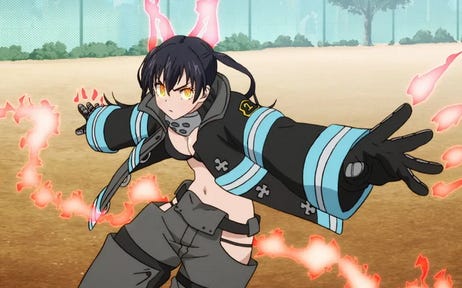
I want to bring up Fire Force for this section. I’ve never personally seen this anime myself, but I used to be interested in it before my best friend watched it and told me how horrible and invasive the fan service is. It was so bad that he dropped the show. I’ve seen the clips, the screenshots, the gifs. I don’t know how anybody could sit through it. One of the main characters, Tamaki, has this so-called “curse” of clumsiness, in which crazy scenarios occur that often result in her ending up naked or in sexually compromising positions. Her character design consists of a small black bikini top and pants that have holes in the side at her hips. In the third episode of the show, the main character Shinra, “accidentally” grabs her chest (under the bikini top, somehow), and her butt through the holes in her pants, and Tamaki blames this happening on her “Lucky Lecher Lure” curse. They’re both 17. And this is only one example out of many in the show. I remember being disappointed to learn these things about Fire Force, as the premise of the anime sounded interesting otherwise.
There are countless instances in anime where characters, both male and female, will grope a female character’s chest without consent, so I won’t point them all out or we’d be here forever. But I hate how it’s portrayed as casual or silly for laughs. The amount of hot springs or public bathhouse scenes where a female character with a small chest, jealous of her friend’s large chest, will suddenly feel on her friend and talk about how nice it would be if hers were that size, is just unnecessary. I also hate how the characters being groped just accept that their friend essentially assaulted them.
Let’s talk about BL for a second. If you don’t know what that is, it stands for “Boy’s Love”, anime and manga that focus on gay relationships. Many stories portray sexual harassment and even straight-up rape as something “romantic” or “sexy”, and this really bothers me. Many BL stories normalize victims of sexual violence eventually falling in love with their abusive pursuers, depicting their controlling and possessive actions as just being a manifestation of their intense love. Before reading any BL, I look into them ahead of time to make sure I’m avoiding these types of stories. There is a recent trend in more healthy depictions (e.g. Sasaki to Miyano), thankfully, so it’s easy enough to avoid. But I still wanted to call attention to it.
“The Pervert Character”
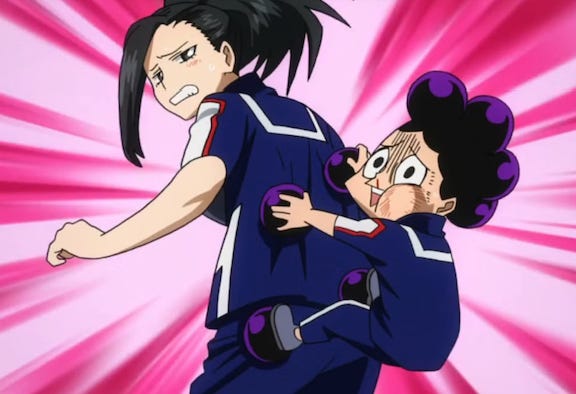
We can’t conclude our discussion on sexual assault in anime without mentioning the infamous “pervert character” trope. These characters are bothersome lechers that prey on the poor female characters. Many action-oriented anime with a teenage boy demographic have at least one. In Boku no Hero Academia, we have Mineta. In Inuyasha, there’s Miroku. In Naruto, there’s Jiraiya. Oftentimes these are annoying side characters that barely have any bearing on the plot. Mineta seems to exist solely to thirst over and harass his female classmates; the story would hardly be impacted were he removed entirely. I despise these types of characters for the same reason I hate panty shots; it’s unnecessary, and uses the sexualization of women and girls for some unfunny running gag.
The discussion of “the pervert character” becomes more complex when it comes to characters like Jiraiya, however. At first, he’s portrayed as unserious, one-dimensional, and creepy. But he actually turns out to be quite important, playing a pivotal role in the story. Because of the depth of his character, I actually grew quite fond of him. Jiraiya’s death was one of the most impactful deaths in the entire series because of his relationship to Naruto; he wasn’t just a mentor to Naruto, but also a father, or grandfather figure. He was a well-respected, legendary ninja, and his actions throughout the story largely shaped several story arcs. I can let go of his early appearances where he only seemed to have women on his mind, because he proved to be a three-dimensional character who was more than just a pervy old man. It’d be hard not to care about him, and he can’t be chucked from the story in the same way we could do without Mineta.
Thankfully this trope is starting to die out. I don’t watch as much anime as I used to, so maybe I’m missing more recent examples, but I don’t see this character trope being utilized as much as it once had.
Normalization of Minor-Adult Relationships
When I was a teenager, one of my favorite manga was a shoujo romance called Dengeki Daisy. I never finished it, but it was really sweet and cute from what I remembered. I shipped the two main characters Teru and Tasuku so much. Recently I thought I should go back and finish it, so when I looked it up on AniList, I noticed the characters’ age gap; Teru was 16 and Tasuku was 24. I don’t know if my teenage brain glossed over this fact, or if I’d simply forgotten it (it’s possible, because when I was a kid I didn’t take issue with certain problematic themes the way I do now). Either way, this realization tainted one of my favorite romance stories. The cool and dependable Tasuku was now just reduced to a groomer in my mind. I couldn’t enjoy this in the same way I once had as a naive teen.
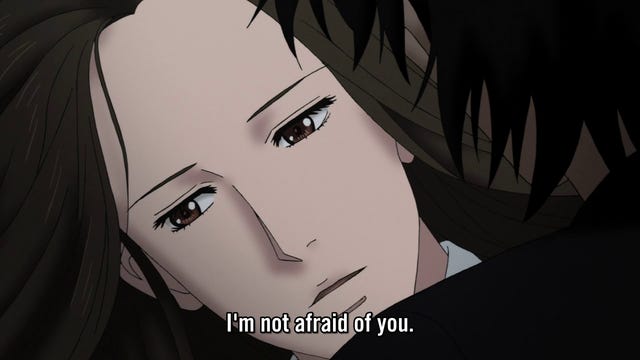
One of my favorite anime also has this problem. This is one of those “if you just ignore this part, it’s good” examples I was talking about earlier. In Kids On The Slope, the second-year high school student Yurika falls into mutual love with college student “Brother Jun”. To be fair, I don’t recall the show specifying Jun’s age; if he was a college freshman at 18, it’s something I could more readily accept, as the age gap would only be two years. But if he were towards the end of college in his 20s, it’s definitely unacceptable to me. The series portrays their relationship as a bittersweet whirlwind romance, and not once does their age gap come into question or under scrutiny. Many romance anime normalize the grooming of teenage girls by treating older adult men as mature and coveted. It’d be one thing if these were one-sided crushes, but too often do these grown men actually covet the teenage girls back. The more I see this in animanga, the more I’m frustrated with the reluctance to call it what it is; romanticizing pedophilia.
Normalization of Incest and “Inseki”
No more incest and inseki plots, I’m begging you. This one might be the most pervasive and normalized I see today. So many of my favorite, otherwise good anime have this BS in them. For those who don’t know, “inseki” is “sexual or romantic relations among step, adopted, and other non-blood related family members”. In my opinion, this is still incest, but so many anime portray it as being fine because well, we’re not actually family. Even though we lived together as parent and child, or were raised together as siblings since we were young. It’s just effing weird. I really don’t want to hear the arguments for loopholes or discourse on the legality of it, you’re still family. It’s off-putting, and mangaka will sneak it into their stories willy-nilly, tainting something I otherwise had no problem with.
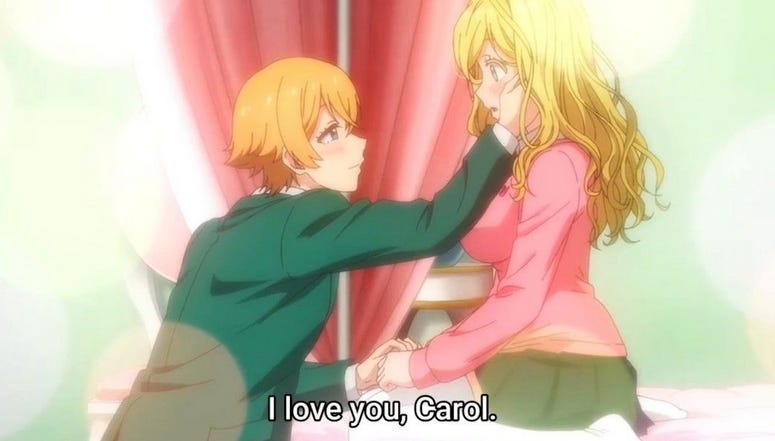
A prime example is Tomo-chan is a Girl, an anime I really enjoyed. My beef is with Carol and Kousuke, cousins who are in love with each other. It’s not subtle, or implied, or a joke, there’s a whole scene where they explicitly state their feelings for one another. I don’t care how much the mangaka tries to soften the blow by stating that they’re distant cousins. Because Carol is fully English and Kousuke is only an unstated percentage English. Does that make it any better? Can’t be that distant, because that boy has blue eyes and blonde hair just like Carol. They tried to make the confession scene cute and emotional too, and I remember sitting there with my eyes glazed over, waiting for it to be over with.
When I was a kid, I watched this cute iyashikei anime called Usagi Drop, about 30-year-old Daikichi raising his grandfather’s secret illegitimate child after he passed. The anime was only 11 episodes, and it was fine, very wholesome. When I was older, I learned that the manga was much longer than what the anime covered, and it wasn’t a full adaptation. In the manga, there’s a timeskip where Rin is now a high schooler. She finds out she’s not actually blood-related to Daikichi and was adopted by his grandfather before he passed. Rin confesses that she developed romantic feelings for Daikichi, who refuses her at first, but ultimately agrees to be with her as lovers once she’s an adult. This absolutely disgusted me. Not only did Rin develop feelings for Daikichi before she found out they weren’t related, but she fell in love with her parental figure, and to make matters worse, that parental figure accepted her romantic feelings. At no point prior did Daikichi ever show romantic interest in Rin while she was still a minor to my knowledge, but it’s still sickening that a father would see the child he raised in a way other than family. The story is forever ruined for me because of this ending. Usagi Drop is a story that betrays its audience.
Is There Hope?
When I was a kid, anime wasn’t as popular as it is now, and I was often made fun of or judged for liking it. With issues like these, it’s not hard to see why. But anime isn’t a monolith. The medium has changed a bit over the years, and I sometimes see anime expressly condemning the things I listed above. For example, Tasogare Outfocus and Kageki Shoujo!! are both anime that responsibly handle the topics of grooming and pedophilia, portraying them in a negative light that has caused harm to the main characters. Dungeon Meshi, a fantasy adventure anime with several female characters, doesn’t rely on fan service for laughs, its witty writing achieves that on its own (although I guess we’ve seen Senshi’s underwear a couple of times, but at least he’s a grown ass man). And a recent personal fave of mine, Medalist, appropriately and healthily portrays a relationship between an adult and a minor; Tsukasa serving as Inori’s coach and number-one supporter as she works to fulfill her dream to be an Olympic gold medalist in ice skating.
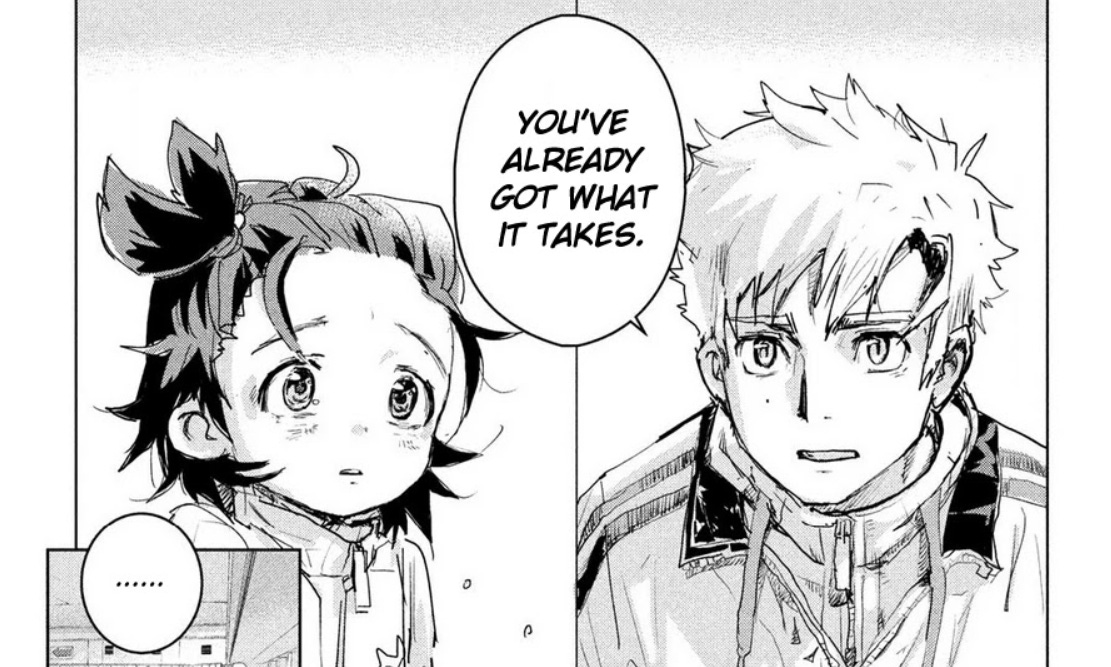
As I often see the same fatigue expressed by other anime fans, I’m hopeful that more and more mangaka and anime studio writers will be encouraged to leave these problematic subjects in the past, and handle serious topics with more care. It’d be nice to someday watch anime without being jumpscared by an incest plot twist, or recommend anime without having to tack on “hear me out!” to my explanation on why it’s good despite [insert problematic content here].